Wednesday, April 18, 2012

All About Julie! and no-bake brownies


A while back, I blogged a Pesto recipe which I recently discovered is actually from the creative mind of Julie Morris. Three weeks ago Julie Morris, author of Super Food Cuisine, gave a talk about plant-strong nutrition and did a smoothie demo at the Chelsea Whole Foods. I’ve followed her in the past and was pretty excited for the event. However, Whole Foods really dropped the ball by failing to prepare for the event. Starting about 45 minutes late, with only a small crowd, it was still an excellent demo and I learned several new ways to incorporate “super foods” into my daily diet (not only was Whole Foods unprepared, but their customer service team was telling people the event was at a different Whole Foods, which helps explain the small turnout). Julie is an incredible chef and her recipes are amazing, but she is also an incredibly warm-hearted, knowledgeable, and fun person to be around!


Among other things, Julie talked about chocolate. To me, this sounds like a chef after Abby Bean’s heart, rather than my own, but Julie quickly clarified that raw cacao has one of the highest antioxidant counts of any food as well as an excellent source of magnesium, which can help relieve muscle cramping. As such, raw cocoa is an excellent addition to anyone’s diet, particularly females and athletes. 


After her talk, she was kind enough to sign my cookbook and even gave me a few other goodies. A few weekends ago, I finally got the chance to crack the spine of the book and go to work. Keeping her message about cacao in mind, I decided to make Julie’s incredible-looking raw and gluten-free, No-Bake Brownies!

Right off the bat there was several things I liked about the recipe. It appeared to be very easy and only required a handful of ingredients. I also like that it required only a short prep time and no cook time. Too often raw deserts require exotic, nearly-impossible-to-find ingredients and two or three days in a dehydrator. These brownies take a total time of 10 or 15 minutes and the ingredients can be found almost anywhere. As Julie notes, if you cannot find raw versions of some of these ingredients, you should simply substitute raw for the least processed you can find. 


To make these delicious little morsels, do as follows:

    1 cup soft dates, pits removed
    1 cup raw walnut pieces
    ½ cup cacao powder (I used Navitas Naturals)
    1 tablespoon cacao nibs (I used Navitas Naturals)
    pinch of sea salt

Place the walnuts into a food processor and grind until they are a coarse flour. Then while the machine is still running, add the dates, cacao powder and the sea salt. Keep the food processor running until all the ingredients are well mixed. If the dates are a bit dry, you may need to add a bit of water. Add just enough so that the mix sticks if you pinch it together between your fingers.


The mix

Now transfer the ingredients into an 8x8 pan (or a pan of similar size) sprinkle in the cacao nibs and begin pressing the flour and the nibs together with your hands. They are now ready to serve although I found that letting them chill in the refrigerator for an hour or so is best, as the oil from the walnuts gets reabsorbed. 


The brownies are truly remarkable! They contain only natural sugar from dates, are filled with good EFA's from the walnuts and are packed full of anti-aging antioxidants! Perfect for after hard workouts or as a scrumptious dessert! 

I should add my sister-in-law and I made these again last weekend while I was in North Carolina and I can now say these brownies are also three-year old approved!


see you out there and a special thanks to Julie!

Thursday, March 29, 2012

An Inconvenient Truth; Local or Vegan?


Recently I’ve seen a lot on local foods. I even attended a presentation on the importance of supporting green markets, co-ops and local farmers back in January. As the bumper sticker saying goes: “No Farms, No Food.” And on a basic level I completely agree. But to what point is local meat acceptable? Clearly, murdering an animal within 100 miles of where you live is no more morally acceptable than murdering an animal across the country, but from an environmental standpoint, where do we stand? What is right; local or vegan?


Over the past few years, the popularity of eating “local” has burgeoned. It has doubled in retail sales, and recently even the environmental disaster known as Wal-Mart announced they are increasing the amount of local food they will carry in each store, currently comprising roughly 9% of all their food sales. This recent surge in popularity is most likely related to the tremendous success of authors like Michael Pollan and Jonathan Safran Foer, both of who urge consciousness when it comes to purchasing food, not to mention the enormous popularity of documentaries such as FOOD inc. With most of our food traveling around 1,500 miles to reach our plates and with gas prices skyrocketing it seems logical that food grown closer to home would have lower transportation costs and would therefore be both more cost effective, but more importantly environmentally friendly.

However, there is one catch. Most “local” eaters also support eating locally raised and slaughtered meat and they typically fail to mention the impact rising animals for food has on the environment. But fortunately, others have begun to make the connection. Ironman triathelte Brendan Brazier’s newest book Thrive Foods and this recent article published in the Journal of Environmental Science and Technology seem crystal clear. Even the United Nations reported that eating less meat is the most affective way to curb global warming.


While the authors of these works admit most food travels around 1,000 miles and 4,000 miles across the entire supply chain, transportation costs comprise only 11% of the total carbon footprint of that food. Instead nearly 83% of the carbon footprint of food comes from growing and producing it (the other 6% is divided among various steps unrelated to either transportation or production). Essentially, each food has it’s own greenhouse gas intensity level. Red meat has the most intense level, requiring nearly 150% more energy than even chicken. This is in part because cows release a high amount of methane gas. However, they also require more emission-producing care, raising their overall carbon footprint. Thus, beef and dairy are often listed as the two worst foods for the environment, local or otherwise.

The article continues along these lines, and ultimately concludes that shifting your diet away from meat and dairy and towards a more vegan diet even for just one day a week will dramatically lower your carbon footprint- even more than eating 100% local foods.

Livestock consumes more than seven times as much grain as the entire human population eats. According to the U.S. Department of Agriculture, the food that U.S. livestock consumes would be enough to feed around 2.7 times the entire U.S. population if they simply followed a plant-based diet. If you are one of those people who hide behind the fact that you only eat meat from your local farmer (as if to justify participation in terror) Brazier shows, even eating local meat is simply inefficient. Brazier also answers the question about grass-fed beef. “If beef eaters in the United States were to switch to exclusively grass-fed beef,” argues Brazier, “one small steak about once every three weeks is all that would be available. There simply wouldn’t be enough to meet demand. And if more grazing land were to be created, of course deforestation would be the result.”[1]


These numbers speak volumes to me but at the same time, I do not want to suggest people should not buy local foods when they can. Rather, people should put an emphasis on always (or mostly) eating plant-based foods and supplementing their diets with local foods whenever possible. Especially as we move towards warmer months, farmers markets will be offering an increasingly large selection of farm fresh fruits and vegetables. Of course, cutting out that 11% will make a difference in your own carbon footprint and you’ll also be supporting local farmers and local economies, two good ideas from any perspective!


Unfortunately for meat eaters (particularly meat eaters who use the label “liberal” and supposedly care about these issues) this science is getting increasingly difficult to deny or ignore. The Inconvenient Truth that Al Gore doesn’t want us to know about, is no matter how many prius’ you park in the garage or energy efficient light bulbs you plug in, it doesn’t add to a hill of beans when compared to your food choices. There is a Convenient Truth, however. That is, eating vegan is delicious, healthy and easy. 

Best wishes and health,


[1] Brazier, Thrive Foods 40.


Friday, March 16, 2012

Tribute to the Greatest Kale in the World.

To quote Tenacious D, “This is the greatest and best [kale] in the world... Tribute”


Anyone who is anyone knows exactly what I’m talking about. Obviously, I’m referring to Sacred Chow’s organic Dijon Marinated Raw Kale Tapa. It is simply heavenly, and this, coming from a person who is firmly on Team Collards. When it comes to the Chow’s Kale, collards cease to exist! 

Anyway, I was recently invited to a friend’s vegan potluck (a little bit of food activism!) and I was a bit short on time so I contacted my nemesis good friend, Abby Bean for a quick and easy recipe. A while back, The Bean become obsessed with Sacred Chow’s kale and after years of sweet, experimentation, millions of dollars, and tons of wasted and radioactive kale (wait I’m thinking of the Manhattan Project), she finally cracked the secret of the Chow’s Dijon Marinade. Not surprisingly, it’s simple and incredibly healthy! 

Start with chopping two bunches of fresh raw kale. 


I always select firm and vibrant curly green kale. Other types of kale, such as Dinosaur kale also work, but I personally believed dinosaur kale is better to cook with than to eat raw.

After you chop the greens, set them aside, put on your lab coat and step into the laboratory we call the kitchen! This is what you will need:


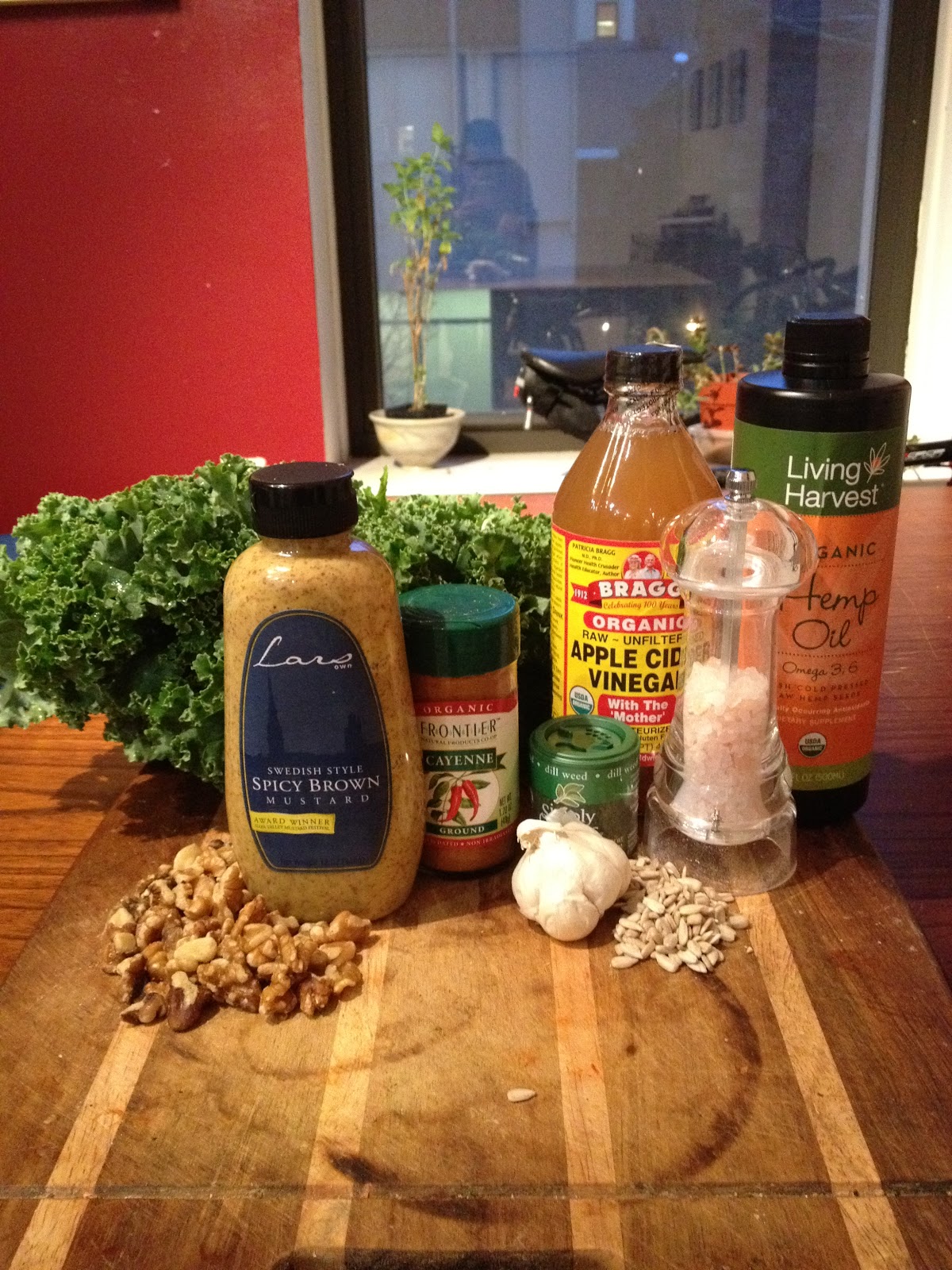
Start by picking high quality mustard. Abby prefers a dijon mustard, which is what they use at Sacred Chow. Because I prefer a little more kick, I chose to use a spicy dijon. Then to increase the antioxidant power of the dressing, use hemp oil instead of Olive Oil. You will also need apple cider vinegar; garlic; paprika; a pinch of salt and I also added some cayenne pepper.


I originally followed Abby’s measurements, however after blending everything, it seems a bit off a a little more "runny" than I wanted. So I added three extra teaspoons of mustard, two extra teaspoons of Raw Apple Cider Vinegar, an extra dash of the spices and an extra clove of garlic. These changes gave the dressing a thicker consistency and a stronger mustard kick! If you have an emersion blender, such as a Vitamix, don’t waste time chopping the garlic, heck! Don’t even peel it, just toss the entire thing into the blender and watch it disappear. 


My slightly altered recipe: (makes enough for two full bunches of kale or several individual servings)

                  8 Tablespoons of Organic, Spicy Dijon Mustrard
                  6 Tablespoons of Hemp Oil
                  6 Tablespoons of Raw Apple Cider Vinegar
                  5 Tablespoons of water
                  2 cloves of garlic
                  slightly less than 1 teaspoon of paprika
                  slightly less than 1 teaspoon of cayenne pepper
                        pinch of salt

(for an oil free version, replace oil with 4 tbsp of veggie broth and increase the amount of mustard/vinegar)

Blend until the dressing is completely smooth and then slowly pour part of the mixture directly onto the chopped kale. This next part is critical. You can not just toss the kale and the dijon dressing. NO! You must massage it. (Please wash your hands very well and then dive in!) As you massage the dressing into the leaves of the kale, slowly add more of the dressing until all of the kale is well covered, but not saturated. 


After thoroughly massaged, put the entire mixture into the refrigerator to chill before serving. This is the way Sacred Chow and The Bean prepare their kale salad; however I spiced it up by throwing a 1/2 cup of sunflower seeds and a 1/2 of raw chopped walnuts to add some Essential Fatty Acids as well as more antioxidants to the mix!


Seriously, you now have an incredibly delicious and healthy starter, and no one will know it took you less than 20 minutes to prepare!

hope to see you out there!
Enjoy


Monday, March 5, 2012

The Carbo-Loading Tradition?


As many of you may remember, I returned from Nepal just a few days before being whisked off to Miami for my first half marathon! Traveling with a large group of friends- all more experienced runners than me- the night before the race I was out voted on what we would do for dinner. Everyone seemed to agree, lentils were out. Italian was in.

We found a small, lovely Italian restaurant somewhere in Miami. Everyone was getting the same thing- pasta.  For those of you who have been with me since my first post know I’m skeptical about the benefits of having pasta in my diet. Actually, to be specific, I think processed wheat products are a detriment to athletes due to their low nutrient value. Anyway, out numbered and hungry I created a custom order. It was a huge bowl of whole-wheat pasta, cannellini beans, kidney beans, spinach, garlic and fresh, diced tomato sauce. In all honesty, it was both beautiful and delicious. 

Sorry I didn’t think to grab a picture of the actual dish!

The next day I awoke at 4 am for the race and I didn’t feel anymore fueled than usual. While I did fine during the race, and so did all of my companions, it got me thinking about how carbo-loading actually works and so here is my understanding of the science behind the tradition. 

The earliest research on carbo-loading dates back to the 60s when Scandinavian scientists studied non-athletic men’s ability to perform on low carbohydrate and high carbohydrate diets. They found that the low carbohydrate diet resulted in lower muscle glycogen stores which negatively impacted their endurance. When the same men consumed a high carbohydrate diet for several days, their muscles became supersaturated, and endurance times were significantly extended. Based off these studies they created a 7-day program. This program has since been replaced and updated although the general idea has remained the 

Other studies have shown more effective approaches. Tapering your workout regimen while simultaneously boosting your carbohydrate intake can allow you to supersaturate your muscles in as little as three days. When used correctly, this method can amplify your endurance by nearly 20%. In practice, this can help you increase your distance without “hitting the wall” as well as your time. Some studies suggest that your time can improve by as much as 2 or 3%. While it sounds like a small increase, in a multi-hour event that will add up to several minutes!


   Okay, so how and when should you carbo-load? Carbo-loading only works for endurance events. Most authorities agree that the performance needs to last at least 90 minutes before carbo-loading will begin to help improve your performance, so unless you are crawling, you probably won’t need to eat a large bowl of pasta every night for a week before your big 5K that you are training for. Instead just try consuming healthy, high-net value foods. These studies even suggest that the most elite marathon runners, those freaks, mutants, people who run 26.2 miles around the two hour mark also don’t greatly benefit from carbo-loading. This is because it typically takes around 90 minutes of sustained exercise before glycogen levels begin to run low. (More elite athletes will be able to train their bodies to sustain themselves off their fat storages during these endurance events rather than depending on carbohydrates.) If however you are running a marathon and you’re not a super human, carbo-loading is a great idea. 


But before you go running off to your local organic grocer to buy them out of whole-wheat pasta finish reading. Gender also plays a role in how beneficial carbo-loading will be. As evidenced from above, the earliest studies were all conducted on men-and those sexists scientists simply believed that women would experience the same results with muscle supersaturation. However, more recently, studies which focused specifically on women found that females have a more difficult time reaching a supersaturate point than men. Another study was unable to demonstrate any measurable benefit to the women’s performance after reaching supersaturation. Part of the reason has to do with the menstruation cycle. Women have an easier time carbo-loading during and immediately after menstruating. Another factor is that women typically have smaller caloric needs than men and simply can't increase their carbohydrate intake enough to gain benefits from it. As such, women may need to dramatically increase their calorie intake for several days prior to an endurance event, paying particular attention to carbohydrates.

Finally, no matter how much pasta you eat the night before a race, no matter how much you gorge, chances are you will not be able to carbo-load that night. To reach a point where performance will actually improve, one needs to eat roughly 4 g of carbohydrates per pound of body weight each day. In a person who weighs roughly 150lbs, that means nearly 2,000 calories in carbos alone! I don’t know about you, but that seems intense!
 
note: Rich Roll no longer rides Jamis bikes.

The final verdict, in my opinion, is that most non-professional athletes won’t be able to achieve supersaturation of glycogen and should instead focus on staying hydrated and eating a large healthy meal before and after the event. As a very close friend always tells me, “you should never try anything new on race day.” That seems like sound advice to me! Luckily for me, green lentils are 70% carbohydrate so I’ll be BYOL’ing for my next endurance event!

Brazier, B. Thrive (2007)
Burke, L. Middle- and long-distance running. (2007)
Burke, L. Preparation for competition. (2006)
Coleman, EJ. Carbohydrate and exercise. (2006) 


Monday, February 20, 2012

Milk Does(n't) the Body Good!


We are told that cows milk is mother natures most perfect food. I couldn’t agree more. It is the most perfect food… for a new born calf. Personally, I think there is no excuse for drinking any sort of dairy milk. Like humans cows do not lactate naturally, people!

However, four recent studies suggest other reasons to avoid dairy besides for animal welfare reasons. 


Back in 2007 this study helped to show that adding cows milk to black tea blocks the human digestive system from absorbing the benefits of the tea. Most teas are very high in antioxidants and vitamins, essentially you’re drinking the goodness of dark leafy greens! However, so complete was the negative effect that when adding cows milk to black tea it completely blunted any benefits of drinking the tea. Perhaps you should learn to like your tea the way you like your men! Or something to that affect.


A year later, a study found when blackberry juice is prepared with defatted milk that there was no increase of ellagic acid absorbed into the blood. Ellagic acid is an antioxidant found to be chemoprotective and also has the ability to reduce blood pressure and as well as to reverse artery wall thickness. Absorption of ellagic acid plasma greatly increased when the blackberry juice was made with water instead.


Then two big studies came out in 2009 that helped to show two things: one that berries are powerful antioxidants with multiple health benefits including helping to reverse brain-function decline due to age; and two that consuming berries with dairy nearly blocks all of the healthy properties of eating the berries. For instance adding fresh strawberries to cereal is always a great idea; however, when you are using cows milk in your cereal, you will block any benefits of eating the strawberries. 

While these four studies all involve relatively small sample sizes, they do suggest that consuming dairy milk may defeat the purpose of consuming other healthy foods with them and force use to wonder what   other negative affects of consuming dairy there are. Perhaps there is a reason why other species do not naturally consume milk past infancy or from a different species. Besides blocking antioxidants from being absorbed into your bloodstream, cows milk is fatty and has high levels of cholesterol. Both are related to heart disease, which is currently America’s greatest killer. While I am not a registered dietitian, I would advise leaving cows milk for the calfs and choosing a more compassionate and healthful alternative such as unsweetened almond milk or sunflower milk! 

GOT MILK? I SERIOUSLY HOPE NOT! 


Sunday, February 12, 2012

ch-Ch-CH-CHIA!


I’m sure that you’ve all heard about the newest craze related to nutrition. Foodies have been raving about Chia seeds for quite some time now. I even know a runner who travels around with a little tube of chia in her bag for moments when she feels like she needs a little pick-me-up. But why? What is the big fuss over such a little seed?


Christopher McDougall, author of Born to Run, compared a tablespoon of chia to a “smoothie made from salmon, spinach, and human growth hormone.” I only eat one of those three so it’s a good thing that chia is around.

The chia seed, while a new rave in the US, played an important nutritional role in the diets of Aztec and Mayan warriors. Often called the “running food” it was used for long distance travel and for nourishment before and after battle.

Today we now know that chia seeds are a complete protein, the highest vegetable source of omega 3 fatty acids, and filled with calcium and magnesium as well as dietary fiber! Truly, a wondrous food.

But how should we use these little guys? Unlike sesame or flax seeds, chia seeds have a digestible outer shell, which means they don’t need to be blended before eaten. As such, they can be sprinkled on top of salads, tossed in marinara sauce or thrown over a bowl of lentils. So powerful are these little guys that one heaping tablespoon a day meets nearly the entire daily need of Omega 3s! That said, I present here a great and simple little desert or a powerful breakfast. Simply put, here is Blueberry Chia Seed Pudding. 


3/4 cup chia seeds
2 cups unsweetened almond milk
Tiny dash salt
1 large banana- ripe
1 cup blueberries

To begin, put the almond milk (or any non-dairy milk in the blender (next weeks post will discuss why this dish should never be made with dairy milk)) with the banana and ¾ cup of the blueberries. Blend until smooth and dark blue.

While that is being blended, add the chia seeds to a large mixing bowl or container. Once milk is done being blended, simply pour it on top of the seeds.


 Now all you need to do is stir once every 5 minutes for the next twenty minutes or so. Similar to flax seeds, the chia will absorb the liquid and obtain a gelatinous texture. The mixture should be done after about twenty minutes of soaking and mixing. The mixture should be now be thick and ready to eat. I prefer it refrigerated and often add the other ¼ cup of fresh blueberries to the top.


Bon Appetite


The best part is, if you don’t like the pudding, you can also use your left over seeds for an elegant plant!


sneak peak: next weeks post is going to be four studies done over the past few years that have shown that the human body's ability to absorb antioxidants becomes compromised when ingested with dairy! 


Friday, February 3, 2012

Compassion is SEXY

UPDATE!!! 
One of my favorite places to get food, the Cinnamon Snail (the first organic vegan food truck)  has just announced that they are having a valentines day menu! Preorders only! Be sure to check them out on facebook for the menu and details on how to order.


Hello all,

Perhaps the silliest holiday of the calendar year is only 11 days away. And while I would be happy with a bountiful bouquet of broccoli, chances are you’re not dating me or even buying me a gift. So assuming you’re dating someone who enjoys the occasional sweet, there is still a chance to give them a gift that shows you care… for more than just them. As Paul McCarthney claims, "going veg can save the world."And since Valentines day is the holiday of love, it is important to remember that compassion is sexy.

So perhaps instead of purchasing environmentally harmful and ultimately wasteful flowers for your romantic partner, and rather than giving them something that causes countless pain and suffering for thousands of animals (not to mention clogged arteries to your partner) choose compassion by gifting a vegan treat and show exactly how sexy you are by showing how much you care!

Looking for some vegan V-day ideas? Check out some of these things.

(Gone Pie!)   

Gone Pie – Bob Dylan lovers everywhere should unite behind this mostly organic, local and gluten free but always vegan bakery! (check out Abby Beans blog for all sorts of positive reviews! Both of us love their goods as well as the owner Barbara- who is a true artist! (Local to NYC but does orders via the web))

Sweet & Sara – Now available in most Whole Foods and also via the web, marshmallow sweets have never tasted better! (Also see Abby’s blog about Sweet and Sara. Sara is also from NYC and is a total vegan rock star!)

Lula’s Sweet Apothecary – This is a NYC gem in the heart of the East Village. Come here and try their handcrafted, all natural vegan ice cream. (Seriously amazing stuff made by an amazing staff!) 


(Sweet & Sara)

In truth, this list can go on indefinitely. And not just for those in the NYC area. Find something local and give it a try. I personally give two thumbs up to: Princeton, New Jersey’s The Bent Spoon; Washington DC’s Sticky Fingers; Atlanta, Georgia's Dulce Bakery; and Toronto, Canada’s Bunners. Chances are you and your special someone(s) (who am I to limit you to one special friend!) will be more than pleasantly surprised. And you’ll be helping animals as well as the environment!

Cheers and stay well,
see you out there!