Showing posts with label Abby Bean. Show all posts

Monday, February 3, 2014

Oil-Free Ethiopian – Plant-Strong Niter Kibbeh and Misir Wett

If I’ve ever contributed something positive and original to the healthy, vegan lifestyle, I truly believe this is it! My friend Abby first turned me on to Ethiopian food almost two years ago. Since then I’ve fallen in love with its unique flavor combinations and the fun that comes along with eating with your hands.


While eating vegan at an Ethiopian restaurant isn’t really a challenge, eating healthy, plant based vegan can be, as essentially all of their food is cooked in a spiced-oil known as niter kibbeh.

When another friend of mine offered to lend me an old Vegan Ethiopian Cooking Zine (remember those?) called Papa Tofu Loves Ethiopian, I decided I would try and create a healthier alternative to niter kibbeh. (Note, Papa Tofu is currently working on a full-scale cookbook, watch out for it, because it is going to be amazing.)


Learning a great deal from reading through the opening of the zine and Papa Tofu’s recipes, I went to work and am now happy to share with you my results which I believe upholds the integrity of the complex flavors associated with this food - without the harmful side effects associated with a high-oil meal.

If you’ve never had Ethiopian, their traditional cuisine is similar to Indian in the sense that it is best to think of each dish as a side, and as such, a complete meal is comprised of several different components. These components are typically served on one large platter and shared between a group of friends or family. True Ethiopian dishes needs to be accompanied by injera – a soft and supple sour pancake-like bread made of teff grain – that is used in place of utensils (Injera over Knives, anyone?) The food is eaten with your hands by ripping small pieces of injera off and then using that to scoop up the various dishes on your platter. That said, this lentil-based dish is delicious on its own as well.

Because Papa Tofu is working on a cookbook, I’m only going to share my recipe for Plant-Strong niter kibbeh and Misir Wett (a delicious red lentil dish sometimes spelled wot or wat) but feel free to search around the internet to find other delicious recipes like Fassolia, Shiro Wett, and my favorite, Gomen. (Whenever I make Ethiopian I typically make 3-5 of these dishes and I buy injera from a local Ethiopian bakery in Harlem, but you can also buy it from any Ethiopian restaurant or try making it yourself).
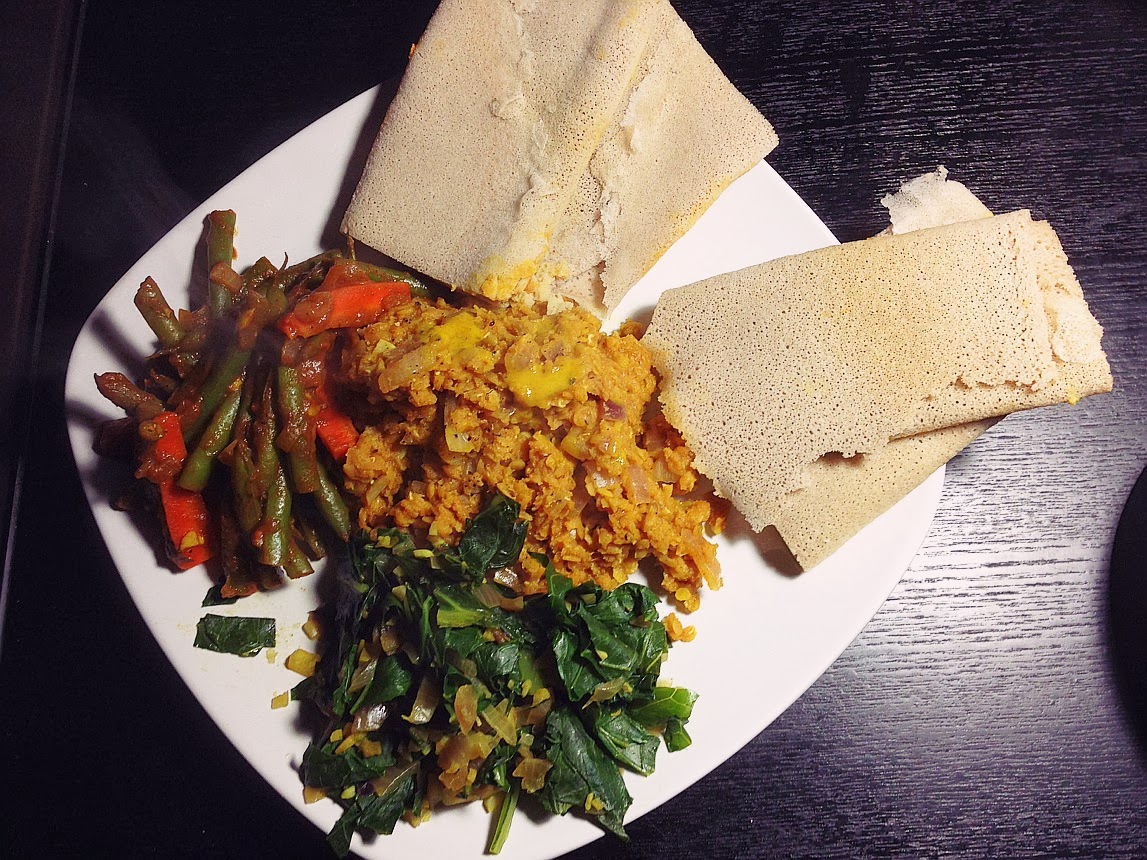


Ethiopian cuisine is not difficult to make; however, because there are often several components to a single meal, be prepared to use several different pots and pans! You’ll also want to make sure you have a nice large container of vegetable broth before you start and it will be helpful if you either buy or make your own Berbere (Burr-burr-ee) spice blend ahead of time. Most stores sell a relatively mild pre-mixed berbere blend, so if you prefer some heat, make your own. I also find it helpful to dice a few red onions, and mince several cloves of garlic and ginger before starting anything else.

Now let’s make some plant-strong niter kibbeh


Plant-Strong Niter Kibbeh (keeps up to 3 days in the fridge)
1 ½ cups of vegetable broth
¼ of a ripe avocado (this replaces the fat of the oil)
¼ cup chopped red onion
2 tablespoons minced garlic (or more to taste)
1 tablespoon minced ginger
½ teaspoon turmeric
½ teaspoon fenugreek
½ teaspoon ground cardamom
½ teaspoon ground cinnamon
6 whole cloves or ¼ teaspoon ground clove
¼ teaspoon ground flax seed (optional)
Pinch of nutmeg

(This recipe makes just shy of 2 cups – enough for an entire Ethiopian meal comprised of several different recipes – with a little bit left over)

In a high powered blender or food processor, add all of the ingredients and blend until completely smooth. If you are using a Vitamix or similar blender, continue blending the ingredients until steam begins to rise out of the lid. If you are using a lower powered blender, transfer the blended sauce into a small sauce pan and bring to a low simmer and then let cool.


Misir Wett

1 ½ cups dry red lentils
3 cups of vegetable broth or water (to cook lentils in)
1 cup of vegetable broth (for sautéing)
1 medium red onion – finely diced
3-4 cloves of minced garlic
2-3 tablespoons no-salt tomato paste or 1-2 medium tomatoes
3 tablespoons niter kibbeh
1-2 tablespoons of Berbere spice
1 tablespoon sweet paprika
1 teaspoon cumin
1 teaspoon coriander
1teaspoon cinnamon

Start by soaking, washing and cooking your red lentils as you normally would. Then place them into a large pot with 3 cups of vegetable broth and cook as you normally would until the lentils are very soft – roughly 25-30 minutes. Once done, drain off any extra liquid.

Right before the lentils are done cooking, heat a pan and add two to three tablespoons of niter kibbeh. Saute the onions and garlic until the onions become translucent. At this point, add the tomato, berbere, and other spices. Mix well and sauté for another 2-3 minutes. Now add 1 cup of vegetable broth and bring to low simmer. (Note: If you want a smoother gravy, you can blend all of these ingredients) Now add the lentils and another tablespoon of niter kibbeh and a tiny bit of vegetable broth and sauté for a an additional 10 -15 minutes.

Note, once finished cooking you can add lightly blend or food process all of this for more of a dipping sauce. 
Serve over an injera lined platter and top with fresh cracked black pepper. 

As always the information presented in this blog is for educational purposes only. It should not be considered as specific medical, nutritional, lifestyle, or other health-related advice.

Tuesday, January 24, 2012

KALE v. COLLARDS

At the beginning of the world, five great rivalries were established. So intense were these conflicts that centuries later Chinese philosophers created the yin yang to help explain the delicate balance struck between each one. The eternal struggles of good and evil, light and darkness, peanut butter and chocolate I mean hot and cold, and dogs and cats have impacted human history in ways still unknown to us. However the oldest and most intense rivalry lies between Kale and Collards. These two dark leafy greens have been mortal enemies since they were first cultivated several centuries ago.


This rivalry runs deep within my group of friends. If you’re a fan of vegan cakes and sweets than you probably already know that my good friend Abby Bean has publically joined team Kale. On the other hand, my nutrition conscious friend Brian is a thorough supporter of collards. (Do note that I am slightly afraid to do this post as I would hate to learn that the only healthy food that A-Soy Bean eats is all a lie! Of course if we learn that kale is no healthier than cake, it would explain the Beans fondness for the cruciferous green.)

Both greens have their benefits but only one can rein supreme!


Kale is a green that grows in both summer time as well as in fall and winter, making it one hardy veggie! One of the most popular greens grown in Europe during the Middle Ages it's growth experienced a renaissance as it was encouraged by the British government during Dig for Victory, a campaign during the Second World War to ensure that rations would not negatively affect British citizens’ nutrition. Growing in nitrogen and lime rich soils, kale is a member of the cabbage family. Also know as borecole, there are several varieties and it even comes in two colors; purple and the more popular, green.


Collards have large, flat edible green leaves making them perfect for raw wraps. Grown in most parts of the world, collards are a cousin to kale, making their nutritional values similar. Having an upright stalk, collards, which is short for colewort, can grow up to two feet tall!


Ready and FIGHT!*

One cup of steamed kale contains roughly 36 calories. Lower in fiber than collards, kale has just 2.6 grams per cup. That said many of its mineral levels are also lower than collards. With 94 mg of calcium, 1.17 mg of iron, 23 mg of magnesium and 36 mg of phosphorus, kale packs a powerful punch. Kale really shines with its 296 mg of potassium and 53.3 mg of vitamin C. Potassium is particularly important in lowering risks of cardiovascular disease and is beneficial to athletes as it helps muscle contraction. One cup of Kale has just 1.9 grams of protein (which is actually a significant amount given it’s caloric weight).

In the other corner, weighing in at whooping 49 calories, we have Collards. Its 5.3 g of dietary fiber helps ensure healthy digestion. Collards also blows away its cousin in calcium, containing 266 mg of calcium, 2.2 mg of iron, 38 mg of magnesium and 57 mg of phosphorus. Collard greens also have roughly 3 grams of protein making this a true super food for athletes of all kinds. Kale just barely tips the scales to its advantage in potassium as collards have 220 and only 35 mg of vitamin C.

Both collards and kale have similar amounts of B-complex vitamins such as thiamine, riboflavin, folate and B-6. They both also have anticancer properties including antioxidants glucosinolates and diindolylmethane. Glucosinolates are responsible for the “spicy” flavor that these two cruciferous greens have. Diindolylmethane has recently been shown to promote a healthy immune system as well as having antibacterial and antiviral properties.

Ultimately, it is hard to determine a clear winner in this fight. Perhaps it comes down to taste preference. When in it’s raw state, I greatly prefer the taste of kale to collards, unless as mentioned above, the collards are used for a burrito-style wrap. 


However, according to Dr. Greger of nutritionfacts.org more nutrients are absorbed when slightly cooked- most-preferably steamed. Personally, I think collards have a slightly more refreshing taste when steamed. Microwaving will kill many of the nutrients. With that in mind, based off these numbers I would suggest choosing collards slightly more often than kale.

Perhaps it is best not to become too wedded to either team Kale or team Collards. I mean both are far healthier than nearly any other food on the planet! Whole Foods’ Aggregate Nutrient Density Index or the ANDI system gives both Collards and Kale a perfect score of 1000! Each has their strengths and weaknesses (which are really not weaknesses at all!) What is clear is that both of these little greens are incredibly healthy and should be implemented in your cooking repertoire.  I try and eat at least two cups or either of them ever single day! I like to rotate between purchasing bags of frozen kale and frozen collards to add variety to my diet. With time you will learn the subtle differences in taste and texture, and if you’re anything like me, you’ll quickly make room in your heart for both!

The final word:
EAT MORE KALE and COLLARDS!


*  These numbers are found on the USDA National Nutrient Database. Please keep in mind that I am not a registered dietitian and that these are simply my opinions.
 Interestingly, the numbers for kale and collards vary greatly between the raw and cooked pages. I chose to use the numbers found on the cooked page as I originally wrote the post using those numbers before realizing the great divergence. However, when comparing the numbers found on the raw page, Kale appears to have significantly higher values of Vitamin C, Vitamin A, Calcium, Potassium, and Protein. It seems unlikely that steaming these greens would so significantly change their properties.