Monday, February 3, 2014

Oil-Free Ethiopian – Plant-Strong Niter Kibbeh and Misir Wett

If I’ve ever contributed something positive and original to the healthy, vegan lifestyle, I truly believe this is it! My friend Abby first turned me on to Ethiopian food almost two years ago. Since then I’ve fallen in love with its unique flavor combinations and the fun that comes along with eating with your hands.


While eating vegan at an Ethiopian restaurant isn’t really a challenge, eating healthy, plant based vegan can be, as essentially all of their food is cooked in a spiced-oil known as niter kibbeh.

When another friend of mine offered to lend me an old Vegan Ethiopian Cooking Zine (remember those?) called Papa Tofu Loves Ethiopian, I decided I would try and create a healthier alternative to niter kibbeh. (Note, Papa Tofu is currently working on a full-scale cookbook, watch out for it, because it is going to be amazing.)


Learning a great deal from reading through the opening of the zine and Papa Tofu’s recipes, I went to work and am now happy to share with you my results which I believe upholds the integrity of the complex flavors associated with this food - without the harmful side effects associated with a high-oil meal.

If you’ve never had Ethiopian, their traditional cuisine is similar to Indian in the sense that it is best to think of each dish as a side, and as such, a complete meal is comprised of several different components. These components are typically served on one large platter and shared between a group of friends or family. True Ethiopian dishes needs to be accompanied by injera – a soft and supple sour pancake-like bread made of teff grain – that is used in place of utensils (Injera over Knives, anyone?) The food is eaten with your hands by ripping small pieces of injera off and then using that to scoop up the various dishes on your platter. That said, this lentil-based dish is delicious on its own as well.

Because Papa Tofu is working on a cookbook, I’m only going to share my recipe for Plant-Strong niter kibbeh and Misir Wett (a delicious red lentil dish sometimes spelled wot or wat) but feel free to search around the internet to find other delicious recipes like Fassolia, Shiro Wett, and my favorite, Gomen. (Whenever I make Ethiopian I typically make 3-5 of these dishes and I buy injera from a local Ethiopian bakery in Harlem, but you can also buy it from any Ethiopian restaurant or try making it yourself).
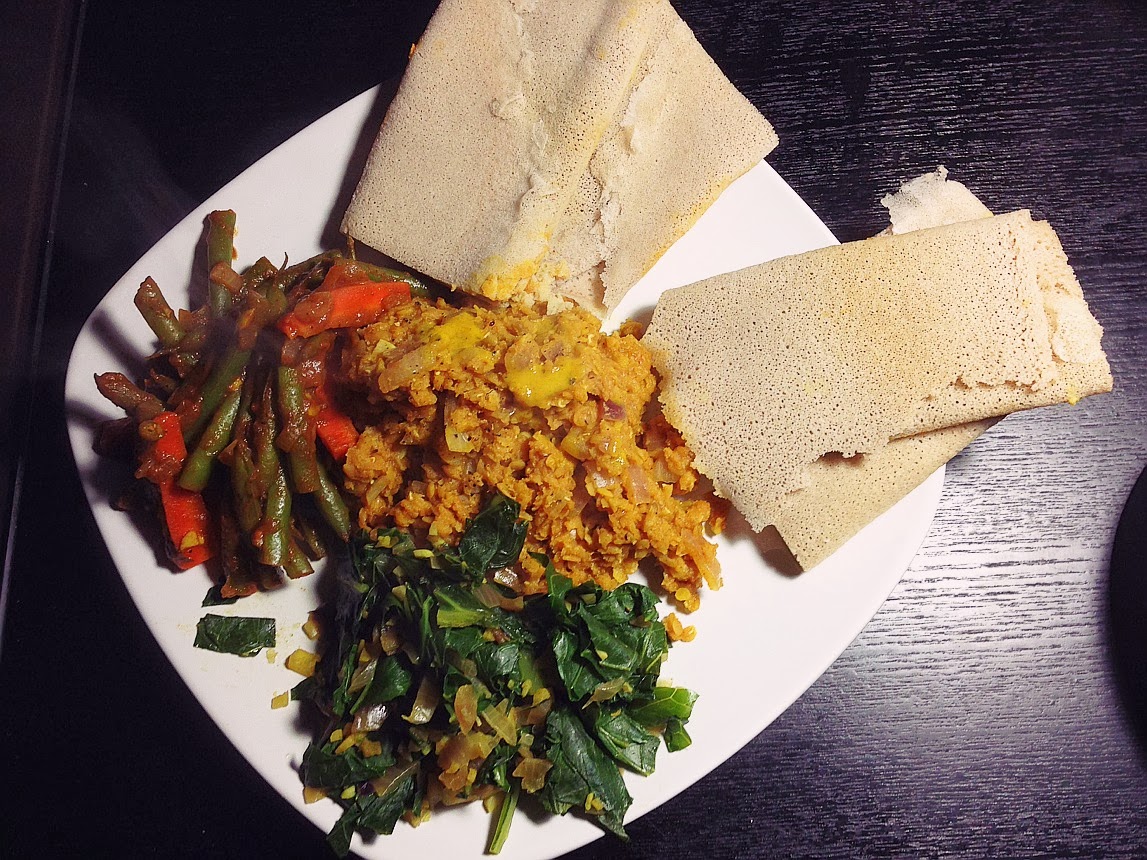


Ethiopian cuisine is not difficult to make; however, because there are often several components to a single meal, be prepared to use several different pots and pans! You’ll also want to make sure you have a nice large container of vegetable broth before you start and it will be helpful if you either buy or make your own Berbere (Burr-burr-ee) spice blend ahead of time. Most stores sell a relatively mild pre-mixed berbere blend, so if you prefer some heat, make your own. I also find it helpful to dice a few red onions, and mince several cloves of garlic and ginger before starting anything else.

Now let’s make some plant-strong niter kibbeh


Plant-Strong Niter Kibbeh (keeps up to 3 days in the fridge)
1 ½ cups of vegetable broth
¼ of a ripe avocado (this replaces the fat of the oil)
¼ cup chopped red onion
2 tablespoons minced garlic (or more to taste)
1 tablespoon minced ginger
½ teaspoon turmeric
½ teaspoon fenugreek
½ teaspoon ground cardamom
½ teaspoon ground cinnamon
6 whole cloves or ¼ teaspoon ground clove
¼ teaspoon ground flax seed (optional)
Pinch of nutmeg

(This recipe makes just shy of 2 cups – enough for an entire Ethiopian meal comprised of several different recipes – with a little bit left over)

In a high powered blender or food processor, add all of the ingredients and blend until completely smooth. If you are using a Vitamix or similar blender, continue blending the ingredients until steam begins to rise out of the lid. If you are using a lower powered blender, transfer the blended sauce into a small sauce pan and bring to a low simmer and then let cool.


Misir Wett

1 ½ cups dry red lentils
3 cups of vegetable broth or water (to cook lentils in)
1 cup of vegetable broth (for sautéing)
1 medium red onion – finely diced
3-4 cloves of minced garlic
2-3 tablespoons no-salt tomato paste or 1-2 medium tomatoes
3 tablespoons niter kibbeh
1-2 tablespoons of Berbere spice
1 tablespoon sweet paprika
1 teaspoon cumin
1 teaspoon coriander
1teaspoon cinnamon

Start by soaking, washing and cooking your red lentils as you normally would. Then place them into a large pot with 3 cups of vegetable broth and cook as you normally would until the lentils are very soft – roughly 25-30 minutes. Once done, drain off any extra liquid.

Right before the lentils are done cooking, heat a pan and add two to three tablespoons of niter kibbeh. Saute the onions and garlic until the onions become translucent. At this point, add the tomato, berbere, and other spices. Mix well and sauté for another 2-3 minutes. Now add 1 cup of vegetable broth and bring to low simmer. (Note: If you want a smoother gravy, you can blend all of these ingredients) Now add the lentils and another tablespoon of niter kibbeh and a tiny bit of vegetable broth and sauté for a an additional 10 -15 minutes.

Note, once finished cooking you can add lightly blend or food process all of this for more of a dipping sauce. 
Serve over an injera lined platter and top with fresh cracked black pepper. 

As always the information presented in this blog is for educational purposes only. It should not be considered as specific medical, nutritional, lifestyle, or other health-related advice.

Wednesday, January 15, 2014

Iron Deficiency and Anemia

Recently a good friend of mine told me that she was diagnosed with anemia. She has been vegan for as long as I have known her (at least five years) and is the first vegan I’ve met who actually had a mineral deficiency of any kind. While I can’t go into specifics, I do know she follows a mostly health promoting lifestyle. Besides generally eating well she is also an accomplished Ironman athlete. Some of the symptoms she felt included general fatigue and dizziness but other signs of anemia include: pale skin, rapid heart beat, shortness of breath during exercise, headaches, insomnia, and muscle cramps. 

She reached out to me for a little advice and happy to oblige I started doing a little more in-depth research. This is what I found.

The main function of iron in our body is to create hemoglobin, which helps facilitate red blood cell health. An adequate iron level is of paramount importance as it ensures the cells are able to deliver oxygen-rich blood throughout the body. Iron also plays a role in building blood proteins needed for food metabolism, digestion, and proper circulation.


First, while my friend is anemic, meaning she does not have enough iron in her system, having too much iron is equally dangerous – watch for a fuller post on this subject in the future. While it is relativity rare to be diagnosed, iron toxicity typically occurs in those who eat meat. This is because of the type or “quality” of iron in animal vs. plant foods. People obtain iron from either eating plants or from eating animals that have been fed plants. It is then absorbed into their bodies through the upper gastrointestional tract. Plant foods contain what is known as non-heme iron. Animal foods contain non-heme iron but also has whats known as heme iron or “blood iron.” 

Traditionally, we our told that heme iron is more easily absorbed by our bodies and therefore of a higher quality, but that view is starting to be questioned as excess iron has increasingly been linked to Alzheimer’s disease, a double digit increased risk in colorectal cancer, type II diabetes, and coronary heart disease. Heme iron intake has also been associated with increased risk of stroke, gestational diabetes, gallstones, and cancers of the prostate, lung, stomach and kidneys, among others.   

Our bodies are remarkable. Because the human body doesn't have a mechanism to rid itself of excess iron, we evolved a way to regulate its absorption. When our bodies have sufficient storage levels of iron approximately 5% percent of the iron present in food is absorbed, when a person is iron deficient, then the amount absorbed from the foods eaten can increase by as much as 20%. However, studies have found that the body has a much more difficult time regulating the absorption of heme iron, making iron toxicity or iron overload much more possible.

Now, back to the original topic of anemia. I want to stress that it is very possible to become anemic on any type of diet. Vegetarian’s levels of Hemoglobin, which reflects the amount of iron in the blood, are comparable to those in people who eat flesh. In a review by Craig McPherson, M.D., he stated that while iron stores may be lower in vegetarians, there is no reported increase in incidence of iron deficiency anemia. In fact, iron reduction has been shown not only to decrease the risk of getting various types of cancer by 35%, but anemia has actually been found less frequently overall in those who eat a strict vegetable based diet than those on the Standard American Diet – this is potentially caused by the consumption of large amounts of dairy in the Standard diet, which can bind and inhibit the body from absorbing iron.

Back in July when I had my blood tested, my hemoglobin levels were found to be in the ideal range so I don’t overly concern myself with iron (Hemoglobin A1C: 5.1 which also puts me at a lower risk of diabetes). That said many plant foods that I regularly consume are high in iron. Dark leafy greens and dried beans are perhaps the best sources of non-heme iron. Not only is kale, collards, and spinach all high in iron but they also contain vitamin C, which helps the absorption of non-heme, and are overall, healthy for everyone to consume. In fact, per 100 calories, cooked spinach has more than 15x the amount of iron than a steak! Soybeans, lentils, tofu are also all excellent sources - and all higher in iron than steak per 100 calories-and are accessible and affordable.


However, sometimes just eating foods high in iron won’t be enough, as my friend recently found out. The good news is just because she was diagnosed as being anemic, doesn’t mean she needs to turn to meat. Nor does it necessarily mean she should start gulping iron supplements. Dr. Michael Greger of nutritonfacts.org suggests that those who are diagnosed with anemia talk with their physician about first trying to get their blood hemogloblin levels up through diet alone, because a recent study found an increase in oxidative stress in the body when using suppliments.

Luckily, there are many things we can do to help encourage our bodies to absorb non-heme iron found in our food.

As I mentioned above, vitamin c rich foods helps our bodies absorb non-heme iron. While dark leafy greens have both iron and vitamin c, if you are eating a food that is lower in vitamin C such as chickpeas, it is best if you include a food higher in vitamin c with it such as bell pepper, citrus fruits, broccoli ect. It’s also not a bad idea to avoid taking in tea or coffee as both can block iron absorption.

Another slick trick to help improve the bioavailability of non-heme iron is to prepare your dish with foods such as garlic and onion. The allium family of vegetables foods have phytonutrients that help promote iron absorption. Also steaming your dark leafy greens before eating them can also help improve your bodies iron absorption.

While cooking with cast iron has also been shown to increase the amount of iron content in foods, our bodies are less able to manage the absorption of that type of iron - making it less than ideal for those already with healthy storages of iron.
 
Below is a chart of plant foods high in iron:
Food                       Amount            Iron (mg)
Soybeans, cooked         1 cup                  8.8
Lentils, cooked             1 cup                  6.6
Spinach, cooked           1 cup                  6.4
Tofu                             4 oz                     4.7
Chickpeas, cooked       1 cup                   4.7
Swiss Chard, cooked    1 cup                   4.0
White Potato                1 large                3.2
Quinoa, cooked            1 cup                  2.8
Pumpkin Seeds             1 cup                  2.1
Raisins                          ½ cup                 1.6
Kale, cooked                1 cup                  1.2
Broccoli, cooked          1 cup                  1.1

Source: USDA Nutrient Database for Standard Reference.


Further reading:
Brazier, Brendan, Thrive: The Vegan Nutrition Guide to Optimal Performance in Sports and Life. 2007.

Cook, J.D. “Adaption in Iron Metabolism.” Journal of American Journal of Clinical Nutrition. February, 1990

Stankiewicz, J. and S. D. Brass. “Role of iron in neurotoxicity: A cause for concern in the elderly?” Current Opinon of Clinical Nutrition and Metabolic Care, 2009. 

McDougall, Craig, M.D. “Letter to the Editor: Plant Based Diets Are Not Nutritionally Deficient.” The Permanente Journal. Spring; 17. 

 “The McDougall Newsletter.” Vol 12, Issue 8. The Asian Paradox: End of the Line for Low Carb Diets? Literature Review

Hunt, JR. “Bioavailablitliy of iron, zinc, and other trace minerals from vegetarian diets.” American Journal of Clinical Nutrition. Sept 2003; 78. 

Pulde, Alona, M.D. and Matthew Lederman, M.D. Keep it Simple, Keep it Whole: Your Guide to Optimum Health. 2009.

As always the information presented in this blog is for educational purposes only. It should not be considered as specific medical, nutritional, lifestyle, or other health-related advice.

Wednesday, January 1, 2014

Welcoming 2014 with Open Arms, Eyes, and Hearts.


While I’m not one to set New Year’s Resolutions, I do like to plan for some short term goals as well as set the intention for the upcoming year. I also like to reflect and think back on the previous year. While I typically keep my yearly intentions and goals to myself  – and they are often just race goals – this year I've decided I’m going public with my 2014 year plans to as many people as possible. I’m hoping this will help hold me more responsible to them.

2013 was a year with a ton of ups and downs – like every year. And to expect 2014 to be much different seems naive. However, I am very excited to announce that I am planning on starting the course work necessary to complete a post-bacc so that I can begin moving forward with my long-term goal of becoming a Registered Dietitian.

Since beginning this blog, many people - friends and strangers alike - have written to me asking for help with their diets. I can sincerely say that it is one of the most gratifying experiences of my life.

Since I was trained as a historian, before I can start a master’s program in nutrition science, I first have to go back to the undergraduate level to fulfill some basic science and anatomy requirements that I have not done. I suspect that many of these courses will be difficult for me, but I also believe that I have the dedication, work ethic, and passion to help me get through the process. I also know that I can count on my incredible support network of friends and family. I consider myself very fortunate that my boss just agreed to support my request for class reimbursement, so hopefully most of my class work will be paid for by my job. 


As always, I am also recommitting myself to another year as a compassionate and healthy vegan. I encourage you all to join me, and try eating a healthy, plant-based vegan diet for the month of January. With the holidays over, now is a great time to commit yourself to healthy eating. Get a free 21-day vegan meal plan from Physicians Committee for Responsible Medicine.


I’m also hoping to launch a redesigned and enhanced BYOL site sometime this year. I’ve already started talking with a web designer, but now I just need to commit. I’ll be honest, this is a lower priority for me right now, but I’m hopeful that by 2015 BYOL will finally look like a respectable site!

I also want to announce that I have an upcoming surgery - it's just 9 days away. After several repeated injuries in my lower right leg over the past 3 years, my sports doctor finally linked the muscle damage to a bone growth in the back of my knee. I will be having the bone growth removed on January 9th in the hopes that after I heal, I will be able to avoid these injuries. I already have two Half Ironman events scheduled -Eagleman in Maryland, and the inaugural Princeton 70.3 - so hopefully I will recovery quickly and will be able to get back to my current fitness level relatively quickly.   

I hope you all had an enjoyable New Year and that the closing of 2013 was a pleasant one. And as always, I want to thank all of you for continuing to follow my musings about the power of plants, proper nutrition, and sport. I promise you all that BYOL will continue to offer the latest research on nutrition, as well as many new and delicious plant-based, low fat, high carb recipes. (Yesterday I learned of a new report from the World Health Organization was released stating that meat is more dangerous than cigarette smoking! Exciting times, indeed!) 


Wishing all of you a happy 2014! 


As always the information presented in this blog is for educational purposes only. It should not be considered as specific medical, nutritional, lifestyle, or other health-related advice.


Tuesday, December 17, 2013

Superfood Giveaway from Sacha Vida

At last year’s NYC Veg Fest I met Carlos, the young and energetic founder of Sacha Vida. Sacha Vida is a new company that recently started bringing some of South America’s best superfoods up North to share with us. They pride themselves on their sustainability, and the very high quality of their products.  I have been impressed with Sacha Vida since first meeting Carlos and really loved the sample of Maca they recently sent me. To help build a little holiday excitement, Sacha Vida has agreed to do a giveaway of a bag of their maca as well as a bag of their delicious chocolate covered goldenberries! I know once you try it, you’ll be as convinced as I am about its health benefits and Sacha Vida’s quality.


First tell me a bit about who you are and the founding of Sacha Vida.
Sacha Vida comes to life from my desire to share the amazing super foods that are native to Peru.   After I graduated from college I started to work for an international shipping company and traveled all over the world.  During my travels I always ended up talking about maca and other super foods from Peru and people would always ask me where they could buy such products.  Eventually I started thinking about my own company and ended up leaving my job to work on Sacha Vida full time.  It has been an amazing journey and we are excited and grateful for the great support that our products have received in the U.S. 

I love your company’s mission statement about providing healthy plant-based foods while also preserving the environment they grow in: the Amazon. Can you talk a little about why the Amazon is so vital to protect?
I’ve travelled in the Amazon many times and am always impressed by its beauty and its rich biodiversity.  The Amazon rainforest provides most of the air that we breathe and it is also the best source of natural remedies that could probably cure most of today’s illnesses.   Many people don’t know that  a lot of medications are derived from plants that grow in the Amazon.   The Amazon is also home to many native tribes that have survived for thousands of years only to be kicked out and robbed of their land by industrial agriculture and deforestation.  We need to protect the Amazon in order to ensure that our planet fights back against global warming and to ensure that we protect the natural ecosystems that our planet needs to keep going.

When did you first learn about Maca?
I learned about maca when I was in college, during one of my travels to Peru one of my friends talked to me about this natural powder that he used before he played soccer (we are talking about playing soccer at approximately 10,000 feet above sea level).  I did a little bit of research and found out that the Chasquis, which were high distance runners in charge of delivering messages on behalf of the Incas used maca during their journeys.   I tried maca powder and felt more focused and energized and have been hooked on maca ever since.

Why do you think Maca is such a vital ingredient? How can it benefit us?
Scientists have proven that maca is an adaptogenic plant, that means that it has the capacity to adapt and benefit your body where it needs it most.   For example, a woman suffering from menopause symptoms will  take maca and feel relieved and another woman who is trying to conceive will take maca to produce healthier eggs.  Likewise, an athlete training for a big event will take maca before workouts and a scientist will take maca before going to work.   Maca is a rich source of vitamins, minerals and it also supplies your body with calcium, zinc, iron, magnesium, phosphorous and amino acids.  In addition, maca is known for its aphrodisiac powers and in Peru is known as “Peruvian Viagra.” I heard countless stories of people using maca to enrich their sex lives and to help them conceive.  I use maca for its energizing properties, nothing helps me focus and concentrate better than a spoon of maca in my morning smoothie and I have friends that swear that a maca smoothie before hitting the gym makes their workouts more intense.


What is the best way for us to incorporate Maca in our daily lives?
Best way is to add a tablespoon to your daily smoothie, juice or oatmeal in the morning.  It is best to start gradually and start with one tablespoon in the morning or before your workouts.  

There are generally two types, raw or gelatinized. What is the difference? Which, in your opinion, is better?
People familiar with maca will know that raw maca is a lot cheaper and harder to digest than gelatinized maca.   Besides the digestibility issue you can also tell the difference with the flavor, raw maca has a much stronger flavor that many people dislike or can not tolerate.   Raw maca is made by pulverizing the dry maca roots,  gelatinized maca undergoes an additional step where the natural starches of maca are removed in order to make the maca powder more digestible while concentrating its nutrients.  Some people’s digestive systems are more sensitive and have to work harder to digest starches and other compounds in raw maca, consequently they experience stomach pains or a feeling of discomfort during the digestive process and may not give maca a second chance.  Gelatinized maca powder does not cause those side effects as it goes straight to your system allowing your body to absorb all the nutrients and minerals found in maca immediately.   Sacha Vida currently carries gelatinized maca and so I am biased towards gelatinized maca which in my opinion is a better product than raw maca.  Now, on a related side note, in Peru maca is always consumed cooked and never raw, people who cultivate maca in the Peruvian highlands added it to their stews or toasted but don’t eat it raw.
I also want to highlight that we are the only company in the market that sells maca products that are Fair Choice Certified  which is a certification system based in the International Human Rights Declarations and Labor Conventions.   I support this certification process because it seeks to protect and assure the fair treatment to everyone involved within the control of the company that implements the certification system so it benefits the overall community of growers and producers.   This is the first fair-trade standard created in Latin America that takes into consideration local market and producing conditions and it also includes requirements on health, safety and environmental protection.

Do you have a relationship with the growers of your product? What are the conditions Maca is grown in?
I have a very strong and close relationship to the farmers that produce our maca products.  I visit the maca farms every time I travel to the highlands of Peru and have shared many meals and interesting conversations with our farmer partners.  They are invested in producing a high quality product and are very excited to see that their products are reaching the U.S. market. Maca is usually grown in high altitude lands, where  lots of sunshine during the day and freezing temperatures at night make it difficult for other plants to survive. Maca has adapted to this environment and thrives by absorbing all of the minerals and nutrients from the soil in order to grow and survive. 

Tell me about Sacha Inchi. There is a lot of buzz around the seed of this beautiful star shaped fruit.
I am very excited about sacha inchi finally getting the recognition it deserves.  Sacha inchi is a vine and grows in the Peruvian Amazon, it is a very sustainable crop because you can cultivate it many times a year.  The seed has one of the highest plant based concentrations of Omega 3 fatty acids along with protein and vitamins.  This seed has been consumed in the Amazon for thousands of years and the oil has been used by native women to protect their skin.  What distinguishes sacha inchi from other plant based sources of Omega 3 is that sacha inchi also has naturally occurring vitamin E which helps the oil preserve its properties without oxidizing quickly like flax seed oil for example.  In addition the oil is very light and is a great complement to salads, dips, smoothies and cold dishes.   I recommend that the oil do not be heated because the Omega 3 bonds will break with heat and the nutritional value of the oil is compromised.  Sacha inchi seeds are super healthy snacks, they are full of protein and Omega 3 and are a great additional to trail mixes or enjoyed on their own.  We are currently working on expanding our sacha  inchi line and will have new sacha inchi products available online soon.

Anything else you’d like the readers to know?
We are a family owned company competing with big companies, what makes us different is that our products are always organic and that we truly care about following fair trade practices with our partner farmers.  For example, our maca products are the only ones in the market that are Fair Choice Certified. In addition,  I pick our partner farmers carefully and usually spend weeks with them understanding their processes and learning about their motivations.  I believe that a great part of being a successful entrepreneur is associating yourself with partners who are as passionate if not more passionate than you are about producing and delivering a high quality product.    I grew up in Peru and unlike other entrepreneurs  I am vested in seeing our partner farmers grow and prosper.  Economic development of their communities along with access to education for their children are the first steps in the process.   We have exciting projects in the pipeline with these goals in mind and I hope to share them with you soon.

Besides online, where can we find your stuff? Also what is the best way to connect with you (Instagram, twitter, facebook?)

You can find our products in New York at the Live Live Organic store in the East Village, you can also find us in California at the Rainbow Grocery Coop in San Francisco and in Massachusetts at Cambridge Naturals.  We are always looking to add more stores and if you want to see our products sold in your local store I encourage you to speak to the food buyer at the store  and ask them to add our products to their store inventory. You can always connect with us through our Facebook, Twitter, Instagram and Pinterest accounts, we love to hear from you!

Thanks for doing the interview Carlos! Now for the exciting part. We are doing a giveaway (call it a little holiday gift!) of a bag of Organic maca and chocolate covered goldenberries!


GIVEAWAY
Here are the rules. First, the winner needs to live in the United States (sorry international readers, no disrespect). The contest will end on December 30th at midnight. To enter, you must be a subscribed reader to BYOL. To increase your chances of winning leave a comment on this post or/and "like" "Sacha Vida" on facebook. You will also gain a point if you "like" Bring Your Own Lentils facebook page. 

a Rafflecopter giveaway

As always the information presented in this blog is for educational purposes only. It should not be considered as specific medical, nutritional, lifestyle, or other health-related advice.

Tuesday, December 3, 2013

Cristina's Story


Last year I shared a post from my good friend, Kat and how changing her diet has literally changed her world. I’m happy to report that both her and her husband have continued to thrive on a plant based, whole-food, vegan diet. Today I have another shining example of someone very close to me who has transitioned to a plant based diet and has taken charge of her life, her family's health, and accomplished goals she never dreamed of! I’m happy to share my cousin's, Cristina’s story.

I always thought of myself as a pretty active person. Growing up my parents had enrolled me in ice skating, ballet, and jazz. I spent most of my life in Europe where I also started skiing at the age of 4. Even though I lived in Europe I grew up eating and loving standard American food - processed foods and lots of meat and dairy. Years went by and I met my husband, who was once a ski instructor in his hometown before joining the Army. The two of us bonded on some of the highest peaks of Europe. In addition to skiing, I ran, but never more than a 5K.

I eventually married my ski instructor/soldier, moved to Germany, and had a beautiful baby boy.  We promised each other that we would continue being an active family. I hiked a couple smaller mountains (with baby in tow), ran a race in Prague pushing a BOB stroller but even still, for the first time in my life, I was struggling with my weight. While I’ve always been thin, my post-baby weight was the same as my pregnancy weight, and I could not figure out what I was doing wrong. 

We moved to Fort Benning, GA in 2012. Like your typical Army spouse, I had to start my life from scratch. In an attempt to meet some new friends, I joined the Columbus Stroller Strong Moms and that’s when I noticed how out of shape I really was. I was so intimidated by these women who were running past me with their double strollers, not even breaking a sweat. I often felt discouraged because these ladies seemed to be in such better shape than I was. I could see every single muscle in their bodies. That said I became good friends with many of them and in addition to encouraging me to keep working out and pushing myself, these Mommas taught me to never give up.

In November 2012 I completed my first half marathon, in exactly 2 hours. I could not believe I completed this, but instead of being happy and proud, I saw pictures of myself and could not believe how “big” I looked. I wondered, “how was it that I was working out almost every day and not losing any weight? Why were my knees and overall body always in pain?” I was always active as a younger child and adult; I simply couldn’t understand why I felt as if I was continuously struggling. Initially I thought that I was simply comparing myself to some unrealistic and unattainable goal.


Big Dog Heat Wave Five Miler 2012

My husband deployed yet again, to fill the time I found myself spending an increasing amount of time exercising. I could not get over the fact that I still looked bigger than ever despite the amount of exercise I was doing. I decided to seek medical advice and was referred to a dietician. My blood results showed that I had genetically high cholesterol – 210! My thought was, “I am too young for pills!” I always thought I was eating a healthy diet, but after several long talks and email exchanges with my cousin I quickly realized that I was buying into a lot of hype and marketing. Knowing that my cousin and my aunt were both thriving on a plant-based diet, I began to research and then transition to a cleaner, plant-based diet, with the support of my doctor and dietician. Within the first month I noticed inches come off my midsection, which was the area I struggled with most. My physical performance dramatically increased, and my body felt stronger. Within 6 months I had lost a total of 13lbs. I had muscles where they had never been before. More important than losing a couple of pounds, I felt better - stronger, awake, and energized. Despite having “genetically high cholesterol” my cholesterol dropped to 158!

My race times throughout the year have dramatically improved and in November 2013 I ran my first full marathon in 4:04. I felt a little sore the next day, but nothing more than typical long run soreness. I felt amazing pre, during, and post marathon. I finished the marathon hungry for more.

Some dude getting “chicked” by my cousin.

Changing my diet and my eating habits has been the best thing in my life. I now realize how unhealthy the “healthy” version of the Standard American Diet is. I realized how unhealthy the food itself can be and how it plays a dramatic role in our entire life. I became vegan for dietary reasons, not for ethical ones. Despite this, I DO feel a sense of responsibility when I see how animals are treated and how they are mass produced for human consumption. It definitely puts things in a different perspective. In addition, becoming vegan has proved to be more than just a personal lifestyle change, I feel like I am contributing to our Earth – making it a better place. 

I tell everyone who will listen about my lifestyle change and how well it worked for me. I did not become vegan because of Hollywood trends, nor because I “never really liked meat anyway.” Trust me, I loved steaks and the occasional Big Mac.  I became vegan because I want to LIVE! I want to be an active and healthy person for the rest of my life. I owe it to my husband and my child who are also embarking on their own healthier plant-based journeys. As a family we are more vibrant than ever -  and we were able to do this in the Deep South proving that were there is a will, there is a way!

Always listen to your body, seek professional advice, and experiment!  You will be amazed how being a vegan goes above and beyond eating just kale and various salads. You create meals that the average person had never even heard of and you will LOVE it! Your body will thank you and so will the planet.    


As always the information presented in this blog is for educational purposes only. It should not be considered as specific medical, nutritional, lifestyle, or other health-related advice.